Concepts · Published October 14, 2026
Analytics Events: What They Are and Why They Matter
What an analytics event is, how it differs from a pageview, and why GA4 and PostHog treat named actions as the unit of product insight.
Updated
Quick answer
Quick answer
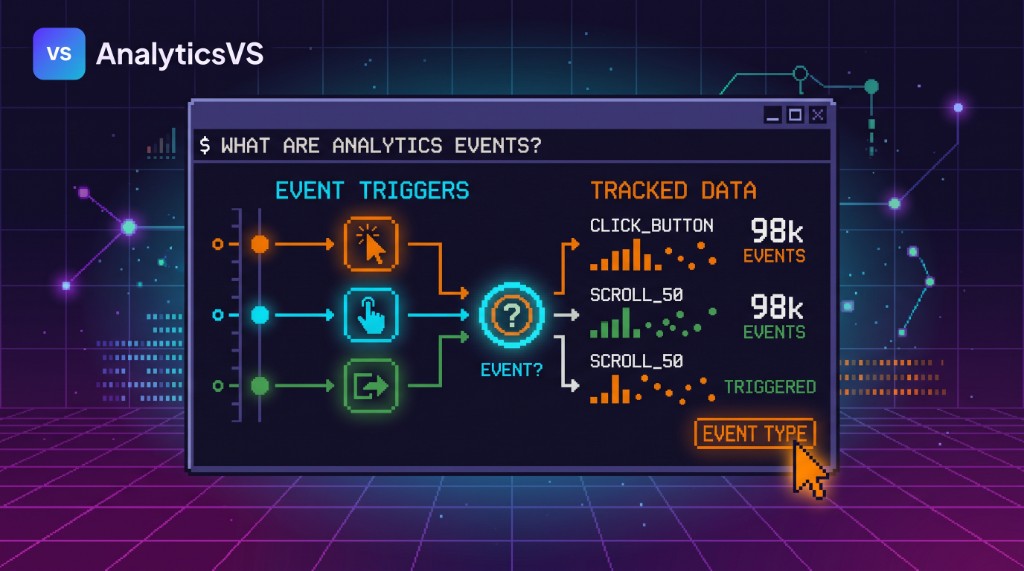
An analytics event is a named action you choose to record — signup, purchase, button click, or pageview. Pageviews are one kind of event; product analytics tools treat almost everything as events so you can build funnels, retention, and revenue reports.
A simple definition
An event is a discrete thing that happened that you want to measure. Clicking "Start trial," completing checkout, watching a video, or loading a page can all be events.
Vendors disagree about defaults — some auto-capture many clicks, others only count pageviews unless you define goals — but the idea is the same: name the action, attach useful context, analyze the counts.
Pageviews are events too
Classic web analytics centers on pageviews and sessions. Modern tools (including GA4) model a pageview as an event with properties like URL, title, and referrer.
That shift matters because the same pipeline can then track:
- Marketing goals (newsletter signup)
- Product actions (created project, invited teammate)
- Revenue (purchase completed)
If you only need "how many people visited /blog," a pageview-first tool like Plausible is enough. If you need "how many invited a teammate within 7 days of signup," you need custom events — and usually a product analytics tool.
Anatomy of a useful event
A durable event usually has:
- A stable name — e.g.
signup_completed, notclick_button_3 - Properties — plan tier, source, error code, value
- Identity rules — anonymous visitor vs logged-in user
- A reason to exist — a decision or dashboard that depends on it
Naming discipline beats volume. Ten well-named events outperform a hundred noisy autocaptured clicks you never trust.
Where tools differ
GA4 is event-based by design and free at high volume, with deep Google Ads ties. Setup and reporting take learning.
PostHog is built for product events, funnels, replay, and flags — stronger inside SaaS apps, heavier script and instrumentation tax.
Plausible / Fathom emphasize pageviews and simple goals; custom events exist but the product stays marketing-site focused.
DataFast tracks traffic and optional payment-linked revenue events for indie SaaS — different primary question than product funnels.
Read the head-to-heads when you are choosing a stack; this primer is only the vocabulary.
What to do next
- List the 5–10 actions that change a business decision (not every click).
- Decide whether you need web analytics, product analytics, or both.
- Compare tools that match that job — then check pricing and recorded script benchmarks.
For the vocabulary gap between counting pages and counting actions, see Pageviews vs Events: Which Should You Track?.
Related comparisons
Head-to-head pages with feature matrices, pricing context, and verdicts.
Google Analytics vs PostHog
GA4 is a free, general-purpose web analytics platform deeply integrated with Google. PostHog is a product analytics suite with event tracking, funnels, session replay, and feature flags — better for SaaS and app teams.
Read morePostHog vs Plausible
PostHog is a product analytics suite for SaaS teams that need events, funnels, retention, session replay, feature flags, and experiments. Plausible is a privacy-first web analytics tool for marketing sites that need clean traffic and goal reports without GA4 complexity.
Read moreDataFast vs PostHog
DataFast is built to answer which marketing channels drive revenue for indie SaaS and Stripe-backed products. PostHog is built to answer how users behave inside your product — funnels, retention, replay, flags, and experiments. They overlap on events and funnels but optimize for different primary questions.
Read more