
DataFast
Revenue-first analytics with Stripe and payment attribution
We may earn a commission. Details
Quick answer
Quick answer
DataFast is the best fit if you run a small SaaS or indie product on Stripe (or similar processors) and need to know which marketing channels drive revenue, not just traffic. Skip it if you need enterprise analytics, session replay, or deep in-product behavior analysis — PostHog or GA4 are better starting points for that.
Features
- ✓Cookieless
- ✓GDPR-friendly
- ✓Realtime data
- ✓Custom events
- ✓Funnels
- —Heatmaps
- —Session recordings
- —A/B testing
- ✓Product analytics
- ✓Revenue tracking
- —Self-hostable
- —Open source
Who is it for?
Good fit for…
- Indie hackers and solo founders shipping on Stripe, Lemon Squeezy, Polar, Paddle, or Shopify
- Teams optimizing paid and organic channels against revenue per visitor
- Multi-project operators who want one dashboard for several small sites (Growth plan)
- Privacy-conscious teams that want lightweight web analytics without a GA4-style stack
Not a great fit for…
- Enterprises needing SSO, audit logs, warehouse export, or advanced access controls
- Product teams that need session replay, heatmaps, or feature-flag-driven experimentation
- Content sites with no payment flow — Plausible or Fathom cover traffic analytics more simply
- Teams that cannot add payment-metadata wiring (Stripe Checkout metadata or Payment API calls)
Revenue attribution
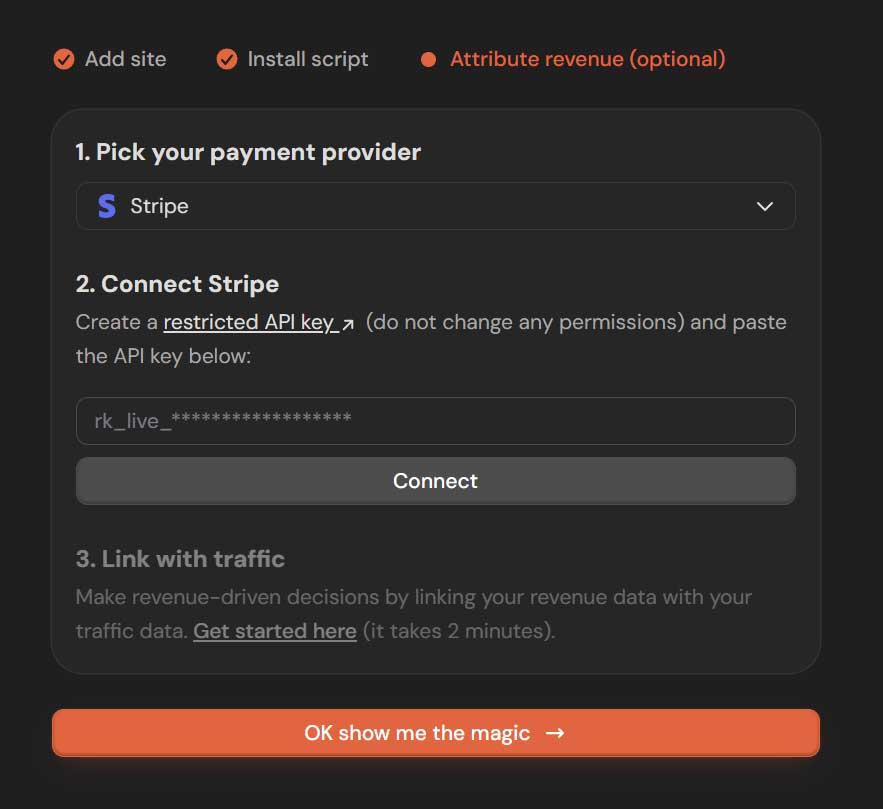
DataFast's headline feature is optional, and that matters. After you add a site and install the script, onboarding offers a third step: Attribute revenue. You can skip it and still get normal traffic analytics. Completing it is what turns DataFast into a "which channel made money?" tool instead of a pageview counter.
Setup has two parts. First, connect a payment provider in Site Settings → Revenue — Stripe, Lemon Squeezy, Polar, Paddle, Shopify, WooCommerce, and similar. For Stripe, DataFast asks for a restricted API key so it can pull payment data into your dashboard. Shopify and WooCommerce integrations can handle more of the visitor-to-revenue link automatically; other stacks usually need a short follow-up step.
Second, link payments to traffic. On the default (cookie) script, DataFast stores visitor and session IDs in first-party cookies. Your checkout needs to pass those IDs into the payment (for Stripe, typically Checkout or PaymentIntent metadata) so DataFast can match a sale back to the referrer, campaign, and landing page. Custom billing can use DataFast's Payment API instead.
This works best for online checkouts with a short path from click to payment. Long B2B deals that close offline are a weaker fit. Cookieless mode also weakens this path — see Privacy & compliance.
Web analytics & funnels
Beyond revenue, DataFast covers standard web analytics: pageviews, referrers, devices, countries, and realtime visitors. You can define goals and funnels to see where visitors drop off before payment.
Compared with GA4, reporting depth is intentionally narrower — fewer dimensions, no BigQuery export, no ad-platform native integrations. Compared with Plausible, you get revenue-aware channel reports that privacy-first tools do not offer out of the box.
If your primary question is "which blog post led to sales this week?", DataFast answers it directly. If your question is "how do power users navigate our app?", look at product analytics tools instead.
Privacy & compliance
DataFast is built as a privacy-friendly alternative to ad-heavy analytics stacks. It does not use third-party advertising cookies or a cross-site tracking network, and it publishes GDPR-oriented documentation.
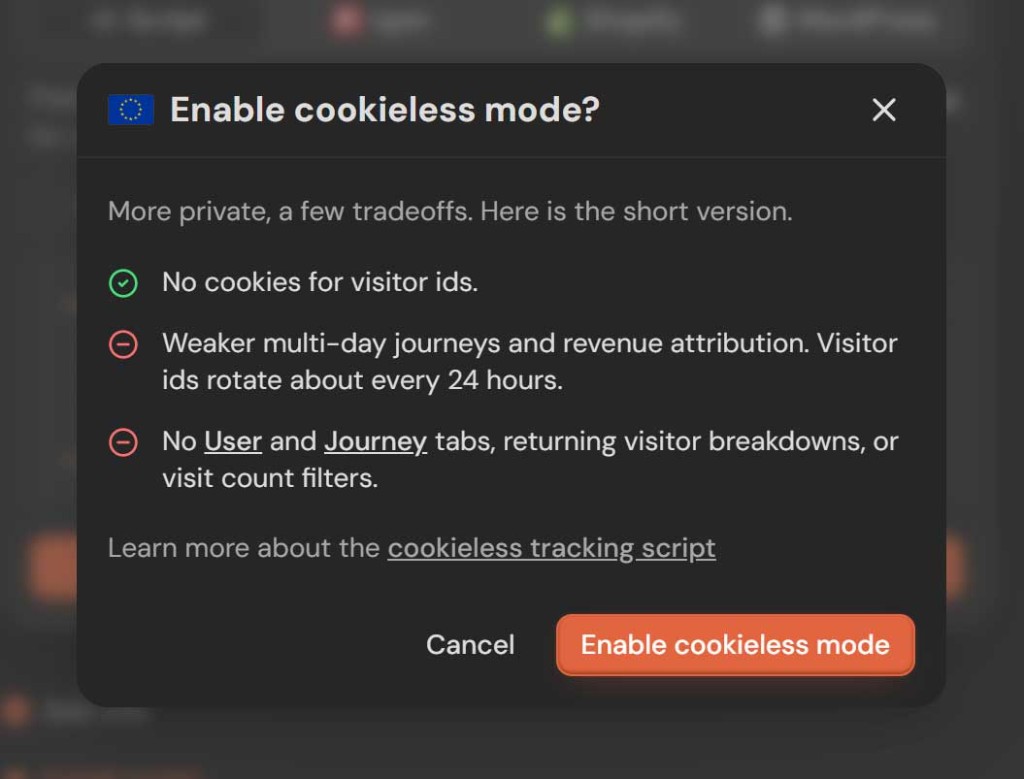
When you install DataFast, you choose how visitor identity works. The default option stores a small first-party cookie so DataFast can recognize the same visitor across visits. That is what makes multi-day customer journeys and revenue attribution work when you connect Stripe or another payment tool.
Cookieless mode turns that off. DataFast's own confirmation screen explains the trade-offs: there are no cookies for visitor IDs, which is better for privacy, but multi-day journeys and revenue attribution get weaker because visitor IDs rotate about every 24 hours. You also lose the User and Journey tabs, returning-visitor breakdowns, and visit-count filters.
If your main goal is knowing which marketing channel led to a sale, stay on the default mode. If you mainly want simpler traffic stats with less persistent identity, cookieless may fit better. Either way, check consent requirements with a lawyer or privacy advisor for your markets. DataFast is cloud-only. Plan retention is 3 years on Starter and 5+ years on Growth according to vendor pricing pages. Teams that need to keep all analytics data on their own servers should look at Matomo self-hosted instead.
Pricing
Plans combine a base subscription with event-volume tiers. Starter is $9/month (10K events, 1 site, 1 seat); Growth is $19/month (10K events, up to 30 sites, 30 seats, extended retention). Higher event bands scale to $299/month at 10M events per our directory data.
Events include pageviews and tracked custom events — heavy event instrumentation increases cost faster than pageview-only analytics. A 14-day free trial (no card required per vendor) lowers evaluation risk.
Use our pricing calculator with pageviews + custom events to estimate your band.
| Tier | Limit | Price / month |
|---|---|---|
| — | 10,000 | $9 |
| — | 100,000 | $29 |
| — | 200,000 | $49 |
| — | 500,000 | $79 |
| — | 1,000,000 | $99 |
| — | 2,000,000 | $149 |
| — | 5,000,000 | $199 |
| — | 10,000,000 | $299 |
Starter plan pricing as of Aug 2026 — verify on vendor site. Growth tier adds multi-site and team features at higher base price.
Use the pricing calculator to compare costs at your traffic level.
Setup & implementation
Typical setup (Stripe SaaS):
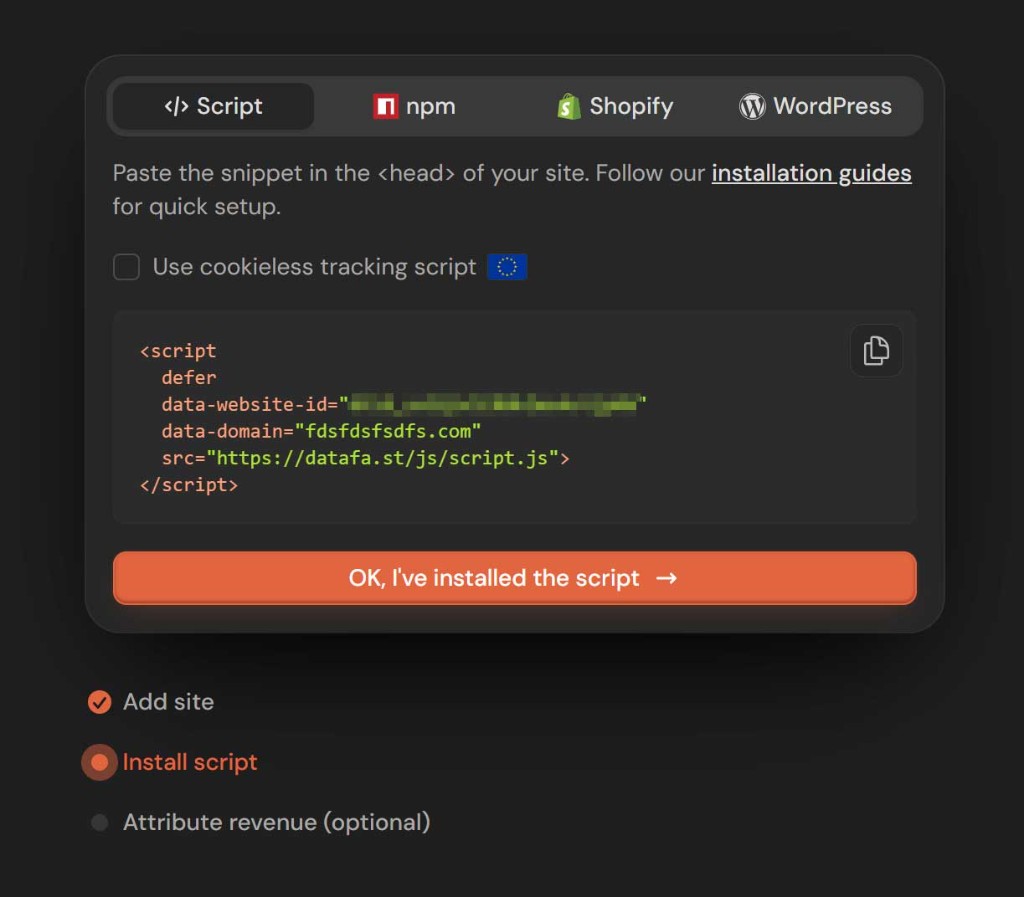
- Add your site in the DataFast dashboard, then install tracking via the script snippet, npm, Shopify, or WordPress path (Next.js has a dedicated guide).
- Choose default or cookieless tracking, then paste the snippet into your site
or app shell. - Optionally open Attribute revenue, pick Stripe (or another provider), and connect it — Stripe uses a restricted API key from your Stripe account.
- Link payments to traffic by passing DataFast's visitor and session IDs into Stripe Checkout or PaymentIntent metadata (or follow the Shopify / WooCommerce guides if those integrations apply).
- Confirm a test payment shows up with referrer and channel data in the dashboard.
For basic Stripe connections, DataFast pulls payment data from the provider API after you connect the key. The metadata step is what ties each sale back to a visit.
Common pitfalls: enabling cookieless when you still need multi-day revenue attribution, skipping the metadata link so revenue appears without clear sources, cookies blocked before payment on a different subdomain, and counting custom product events that inflate tier usage.
Performance benchmarks
DataFast offers two tracking scripts — the default version and a cookieless version — so we measured both under the same conditions.
The noteworthy result is how close they are. Cookieless is a little smaller to download, and neither script blocked the page in our tests. If you are choosing between them for speed alone, there is not much to gain. The real difference is the privacy and reporting trade-off covered in Privacy & compliance. Exact sizes and timings are in the cards below.
DataFast (cookieless) Script Performance
Load time
+231 ms
- Loading method
This script downloads in the background and runs after the HTML is parsed, so the browser can draw the page’s first visible content without waiting on it.
- Script filesize
Transfer is the compressed download size, and decoded is what the browser parses afterward.
What this means for your site
On our empty test page, the load event finished +231 ms later with the tag installed. On a real site, page load is likely to take at least that long — but usually not the full +231 ms stacked on top of your other assets, because much of the work overlaps parallel downloads.
DataFast Script Performance
Load time
+261 ms
- Loading method
This script downloads in the background and runs after the HTML is parsed, so the browser can draw the page’s first visible content without waiting on it.
- Script filesize
Transfer is the compressed download size, and decoded is what the browser parses afterward.
What this means for your site
On our empty test page, the load event finished +261 ms later with the tag installed. On a real site, page load is likely to take at least that long — but usually not the full +261 ms stacked on top of your other assets, because much of the work overlaps parallel downloads.
Comparisons featuring DataFast
DataFast vs PostHog
DataFast is built to answer which marketing channels drive revenue for indie SaaS and Stripe-backed products. PostHog is built to answer how users behave inside your product — funnels, retention, replay, flags, and experiments. They overlap on events and funnels but optimize for different primary questions.
Read moreGoogle Analytics vs DataFast
GA4 is free, deep, and tightly integrated with Google Ads and BigQuery — but revenue attribution for indie Stripe checkouts takes deliberate ecommerce event setup. DataFast is a paid, narrower tool that makes channel-to-revenue reporting the product for small SaaS teams willing to wire payment metadata.
Read morePlausible vs DataFast
Plausible is built for simple, privacy-first traffic analytics on marketing sites and blogs. DataFast covers similar lightweight web analytics but adds optional payment-processor revenue attribution so indie SaaS teams can see which channels drive paid customers — not just pageviews.
Read more


Often compared with
Limitations
- Revenue attribution is optional for traffic analytics, but connecting a payment provider and linking checkout metadata (or using Shopify/WooCommerce integrations) is required if you want channel-to-revenue reports.
- Cookieless mode weakens multi-day journeys and revenue attribution (visitor IDs rotate about every 24 hours) and removes User/Journey tabs and related filters.
- No session replay, heatmaps, or A/B testing — pair with Hotjar or PostHog if you need behavior tooling.
- Cloud-only — no self-hosted deployment.
Frequently asked questions
- Does DataFast replace Google Analytics?
- For marketing sites that only need traffic reports, probably not — GA4 is free and deeper for ad integrations. DataFast makes sense when revenue per channel is the metric you optimize for and you use a supported payment processor.
- Should I use cookieless or default tracking?
- Choose the default mode if you care about revenue attribution and recognizing visitors across multiple days — that is DataFast's main job. Choose cookieless when you prefer less persistent visitor identity and can accept weaker attribution plus fewer journey and returning-visitor reports. In our benchmarks, the cookieless script is only a little smaller to download.
- Which payment providers work out of the box?
- Stripe, Lemon Squeezy, Polar, Paddle, Shopify, and WooCommerce can be connected in the dashboard. Custom billing stacks can use the Payment API with your server sending transaction data after checkout.
- How hard is Stripe attribution to implement?
- Connecting Stripe is mostly pasting a restricted API key in DataFast. Linking each payment back to a marketing visit usually means adding DataFast's visitor and session IDs to Stripe Checkout or PaymentIntent metadata on your site. Skip that second step and you may see revenue totals without clear channel attribution.
- DataFast vs Plausible — when do I pick each?
- Pick Plausible for simple, privacy-first traffic analytics without payments. Pick DataFast when you sell online and need to know which channels produce paying customers, not just visits.
Sources & review status
Explore these tools
We may earn a commission. Details